Thursday, July 10, 2014

Wales Capital, changing the future of the financial industry

Although our research puts emphasis on reward and donation-based crowdfunding, we learnt a great amount about the world of equity and debt-based crowdfunding yesterday. The latter two focus on generating financial profits for investors, in contrary to relying on altruism. The person who educated us on this topic is Kim Wales, founder and CEO of Wales Capital. Her company advises individuals and companies who wish to use crowdfunding to raise capital. She also regularly communicates with politicians to lobby for regulations to unlock the full potential of debt and equity-based crowdfunding.


Kim Wales believes that crowdfunding can open up capital markets to the general public. Currently investing in capital markets is mostly accessible for wealthy investors. Through equity and debt-based crowdfunding, also individuals with lower incomes will be able to profit from financial returns. Mrs. Wales expects a radical change in the entire financial industry with the spreading crowdfunding as an investment vehicle.

We also discussed key success factors. With all types of crowdfunding campaigns trust is very important. People running a crowdfunding campaign should realise that social media alone does not convey enough trust. Personal communication is very important to gain sufficient trust from people to invest in your project.

To hear from Kim Wales about the potential of equity and debt-based crowdfunding was extremely enlightening to us. The concept is still in an infant state, but might rapidly increase in popularity once all regulations are aligned. Wales Capital offers a free consultation service to discuss any questions you have with regard to crowdfunding. The website is walescapital.com.



Sunday, July 6, 2014

Hack Manhattan, a crowdfunded hackerspace

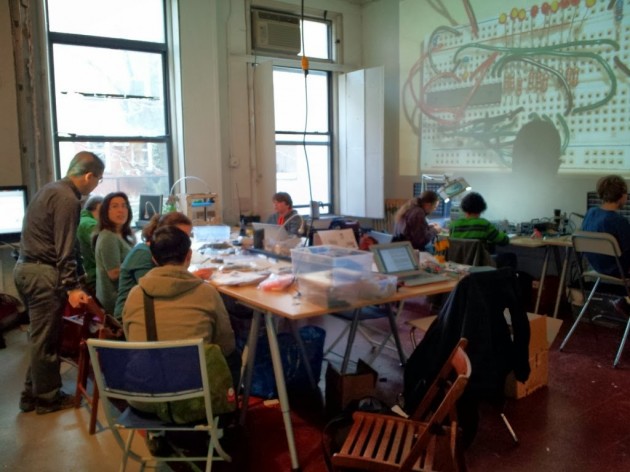
Hack Manhattan is a so-called "hackerspace", which is a workplace filled with tools allowing designers and hackers to realise their ideas. At first, we thought hackers were strictly criminal computer programmers. The hackerspace, however, disproved this completely. The term "hacker" was used in a very different context. It referred to designers adjusting or building electronics for creative means. For example, one of their stunning (crowdfunded) projects includes a ping-pong game that can be controlled entirely by brainwaves:


The community does not have a clearly defined hierarchy or boss, all of the approximately 50 members have an equal status. Every member has a key of the workplace, and has an equal vote for decisions in their regular meetings. Especially this flat organisational structure makes the project unique.

When Hack Manhattan wanted to expand their workplace, they required funding for the removal of a brick-wall. Because no single individual owned or ran the place, traditional sources of funding were impossible. Bank loans are simply not given to a non-profit organisation without making a single person legally responsible. Crowdfunding offered a solution. Due to its simple legal structure, members and others in the community were willing and able to contribute to the expansion of the hackerspace.


Only a few hundred dollar was necessary for the garbage disposal of the demolished wall, so the $1,769 raised was more than enough. The rest of the expansion plans were executed on a voluntary basis. The case of Hack Manhattan really demonstrates the power of crowdfunding for circumventing complex legislation surrounding traditional financing. Crowdfunding can play an important role in non-profit organisations lacking a capital buffer.

We were impressed by the way the hackerspace was run. The small workplace was sufficient to allow for the community to realise and share their unique ideas. Read more about their current projects on their website: hackmanhattan.com!


Friday, July 4, 2014

CrowdsUnite, advising the world on crowdfunding platforms

Wednesday, we have had the chance to interview Alex Feldman who founded CrowdsUnite. His company does not offer a crowdfunding platform, but rather focuses on the education and advising side. CrowdsUnite maintains a database with more than 400 crowdfunding platforms, each of them reviewed with regard to their features, popularity and costs. They also give workshops to entrepreneurs to spread their knowledge on crowdfunding.

CrowdsUnite

One strength of crowdfunding Alex particularly emphasised, was the removal of the middleman. The government can be seen as a large intermediate between the taxes and public goods. By taking out this party, an individual can choose to fund his or her own needs within the neighbourhood directly. Crowdfunding allows everyone to convey their support for a project, which gives direct feedback on the desire of the project. It also creates a community by connecting the people involved in the project.

We also asked Alex whether the growing number of platforms is a positive development. Accordingly, he answered that many crowdfunding websites target a niche market and offer features specific to that market. For example, some platforms are exclusively for the funding of novels. When someone donates, he or she will also be kept up to date on the writing process and potential sequences. Such features do not exists with the larger, well-known general platforms like Kickstarter and Indiegogo. However, he still expects many platforms to cease existing in the future.

If the government would like to stimulate the use of crowdfunding in community projects, Alex would definitely recommend the creation of a custom platform. The city of Rotterdam can also be seen as a niche market, exclusively for its citizens. Alex even hypothesised about converting part of income taxes to credit on the city's crowdfunding platform, so people have a more direct influence on the allocation of their tax money.

We learnt a lot about Alex Feldman's expertise on crowdfunding platforms. If you seek a comparison between crowdfunding platforms we would strongly advise you to take a look on his website: crowdsunite.com

Tuesday, July 1, 2014

Teresa's park, a serene streetcorner in the middle of Manhattan

Our first interview of the week was with Michael Keeler, an initiator of the Teresa's park crowdfunding campaign last year. The initiative to renovate the small grimy street corner came from Mark Fisher Fitness which is a fitness center neighbouring the unused lot. Together with the professional expertise of Clinton Housing Development Company, they decided to raise enough money to plant trees and flowers, build a little terrace and add benches. The result is a green and serene corner open to the community of Manhattan. 

Before

The target of the campaign was $2,500, an amount which was already reached in the first four days! In the end more than 10 thousand dollar was collected. As seen with other projects, the rewards for contributing to the project included the possibility of writing one's name on a plague placed in the park. The clients of the fitness center played a significant role in raising this amount. But, also the neighbouring community played a substantial role by financing and contributing time. Instead of outsourcing the construction process, the largest part was realised by volunteers. 

Volunteering 

Especially the volunteering element led to connecting different individuals within the community. On one hand the people living in the surroundings were introduced to each other, on the other hand the clients of the fitness center got involved with the neighbourhood. Currently, the park is used as a place to have lunch,  but also as an area to organise small events like music nights. 

After

For us this project was especially interesting because it showed how a small scale project can involve a broad community. In the end, a very tangible result is delivered to the neighbourhood. An area which would normally go unnoticed by the local government, has been converted to a pleasant park thanks to the help of crowdfunding. 


Friday, June 27, 2014

Kickstarter, the king of crowdfunding platforms

Kickstarter is by far the largest crowdfunding platform in existence. Up to today 64,391 have successfully been funded through their website. Today we had the honour to visit their brand new headquarters in Brooklyn.


Kickstarter has the most amazing work place we had ever seen. A few months ago the crowdfunding platform Kickstarter moved to an old, yet fully refurnished factory building. An old-school library, spacious halls and an amazing terrace, all filled with young creative minds, combine to a most inspiring atmosphere. And the iced coffee machine was definitely the icing on the cake.


On the top terrace, we had the honour to interview Stephanie Pereira, the person in charge of international and civic partnerships for Kickstarter, therefore the perfect interviewee for our research. She joined the company three years ago, at which only 28 employees worked for Kickstarter. Now, Kickstarter has grown to more than 90 employees and still continues its rapid growth, also internationally. Stephanie recently expanded Kickstarter's coverage across Europe, including the Netherlands.


Stephanie believed the involvement of city government in crowdfunding is improving, but still has much more potential. She gave as an example the current shrinking of art subsidy budgets of local governments due to the economic crisis. Crowdfunding can provide an alternative funding source for artists. Instead of subsidising entire art projects, the government can set an agreement to contribute the last part of the funding target. Thus, when a project raises a large amount, the government recognises the general interest of the public in the art piece. If the project, nevertheless, does not reach its funding target, the municipality has the ability to finance the remaining amount.

We also enquired Stephanie's view on success recipes for civic crowdfunding campaigns. Her main message was that every project is unique, therefore no single holy grail can be identified. One thing she did stress was the strength of transparent ownership of the project. The initiator has to take on a clear identity and communicate intensively with his or her community.

Kickstarter is extremely keen to build partnerships with local governments in order to assist in stimulating entrepreneurship and raising awareness of crowdfunding. When we return to the Netherlands we will definitely connect Stephanie to the relevant members of the municipality of Rotterdam. Cooperation between Kickstarter and American local governments has already been initiated. Following this example, Rotterdam could grab the chance to take a leading position in crowdfunding in Europe.

Interested in contributing to or commencing your own crowdfunding campaign? Have a look on their website: www.kickstarter.com.

Free Bread Inc. gluten-free bread for everyone

We paid an interesting visit to Free Bread Inc. this morning. The company, which bakes and sells gluten-free bread, is run by Karen Freer. In 2008 Karen was diagnosed with celiac disease, meaning she could no longer eat anything containing gluten. During her new diet, she realized that New York missed good, crusty gluten-free bread. At home, she started baking her own. A friend told her to start selling it and gave Karen the first fifty dollars to set up her new business.  Karen was driven to realize her company and heard about the crowdfunding platform Indiegogo. Within three days, she launched her campaign without any preparation to raise $10,500.

The campaign started in 2011 and lasted 100 days. Karen posted a video almost everyday promoting Free Bread Inc. and provided regular updates on Facebook. During the campaign, she developed a business plan and worked on recipes. In Karen’s case, most of the donations she received came from friends and family. She told us that all of the 95 funders received a handwritten thank-you-letter. So next to baking, Karen spent a significant amount of time writing. Other rewards included free hugs (apparently the biggest, goofiest and most ridiculous hug possible), babysit service and a garage clean. The latter was never performed, because who in New York owns a garage? She managed to reach her goal with a final amount of $10,771.

The money raised was sufficient to acquire all the necessary equipment, ingredients, and the rent for a workplace. Free Bread Inc. is now located in the Organic Food Incubator. This facility rents out spaces for startups that aim to sell organic food and drinks. Karen’s gluten-free bread is produced here, together with other products such as organic juices and ice-cream. These different entrepreneurs often work together by providing each other with (parts of) their products.

The atmosphere was great. After a tour of the Organic Food Incubator, we had the chance to try Karen’s amazing Moxy rolls and she was so kind to send us home with an entire loaf of bread! Three years after the campaign, Free Bread Inc. is still up and running and even growing. To see the delicious breads they sell, visit www.freebreadinc.com

Thursday, June 26, 2014

New Work City, a community coworking center

This morning we visited New Work City, which is a community coworking center on Broadway 412. Tony Bacigalupo decided to professionalise a "jelly group" of entrepreneurs in 2010. When the popularity of his jelly group expanded and outgrew cafés and his living room, a crowdfunding campaign was organised to set up New Work City. By raising $17,911, the group managed to rent a large space that gives access to independents to run their business in an inspiring and friendly work environment.

The perks which were rewarded to donators were of particular interest. Ten dollar awarded a simple name reference on their Thank You page, but $100 made you "Mayor" for a day. An entire day you would be in charge of the work place. The largest donation amount was especially noteworthy. One thousand dollars gave the donator a "personalized karaoke party" by founder Tony. As a result, a total of four people backed the project with a $1000 contribution.


The amount that their Kickstarter campaign raised was sufficient to decorate the space, build a kitchen and provide tables and chairs. Nowadays, a sustainable business model allows them to be independent of further donations. A paid membership is required to profit from the offered services, but in return for volunteering a reduction in this fee can be earned. Around 150 persons are currently member and more than 25 individuals are daily visitors of New Work City. Most people come from the direct neighbourhood, but the place is popular for independents from all around New York.

New Work City is an excellent example how a crowdfunding campaign can kickstart a sustainable business model. Their dynamic work space allows entrepreneurs to network and share ideas, which helps people to kickstart their own ideas too. Visit their website for more information here.